Exodus 34:4b-6, 8-9; Daniel 3:52-56; 2 Corinthians 13:11-13; John 3:16-18
My dear brothers and sisters in Christ,
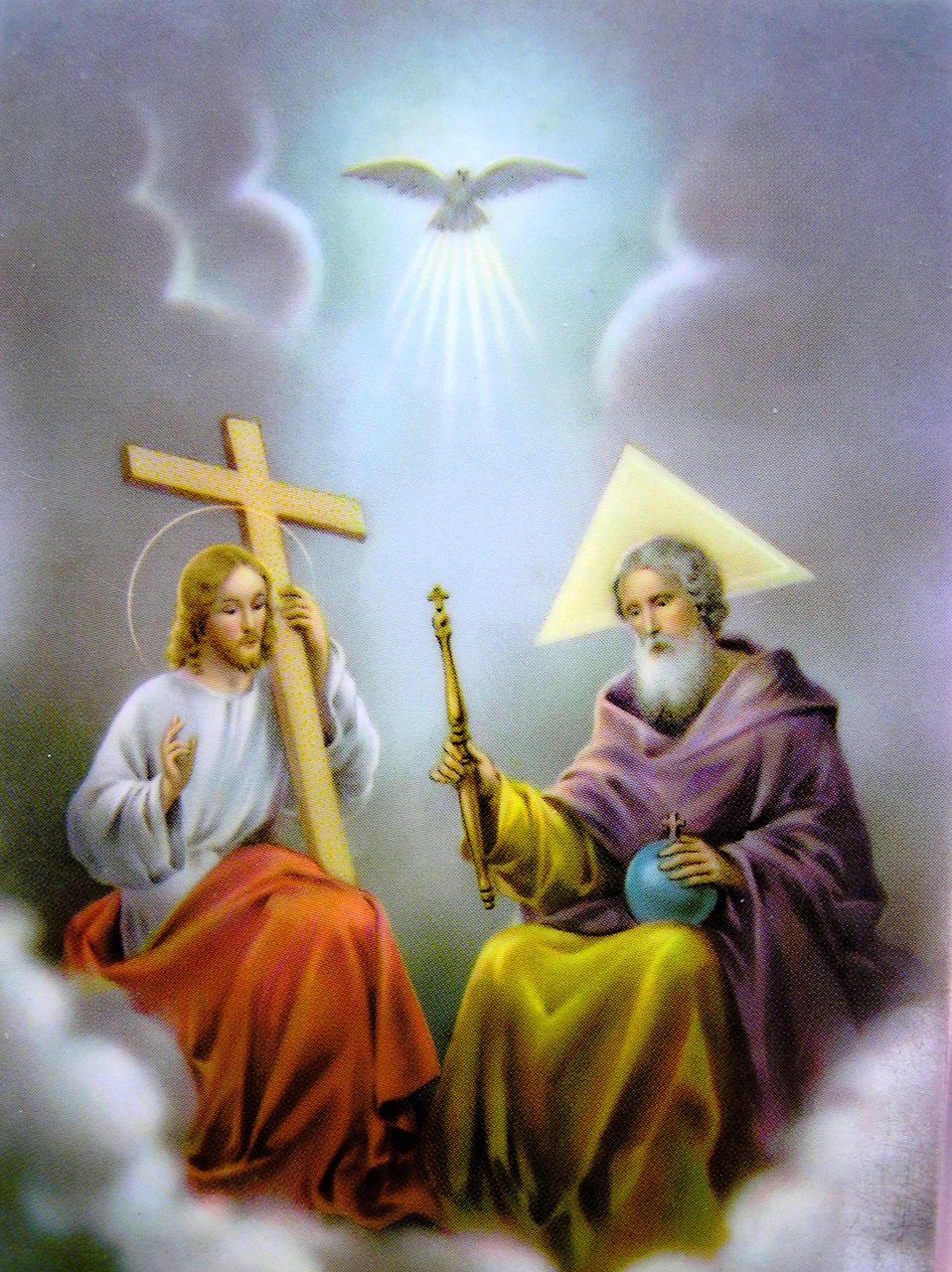
Today the Church celebrates the great Solemnity of the Most Holy Trinity. Every time we begin Mass, make the Sign of the Cross, or recite the Creed, we profess our faith in the Father, the Son, and the Holy Spirit. Yet the mystery of the Trinity remains one of the deepest and most profound mysteries of our faith.
Many people find it difficult to understand how God can be Three Persons and yet One God. Even the greatest theologians struggled to explain this mystery fully. St. Augustine once compared the Trinity to a vast ocean and our human minds to tiny cups trying to contain it. We can understand aspects of the mystery, but we can never fully comprehend God because He is infinitely greater than us.
However, today’s feast is not primarily about solving a theological puzzle. Rather, it is about discovering who God is and what God’s life teaches us about how we should live.
The central truth of the Trinity is that God is love. The Father loves the Son, the Son loves the Father, and this perfect love is the Holy Spirit. God is not a lonely being. From all eternity, God exists as a communion of love. The Trinity teaches us that relationship, unity, and self-giving love are at the very heart of God’s nature.
In today’s Gospel, Jesus reveals this love in a remarkable way: “God so loved the world that He gave His only Son.” Notice that Jesus does not say God merely felt love for the world. God demonstrated His love through sacrifice. He gave His Son for our salvation.
True love always gives. Parents understand this. A mother may stay awake throughout the night caring for a sick child. A father may work tirelessly to provide for his family. Their love is not merely expressed in words but in sacrifice.
Similarly, God’s love for us is not theoretical. It is practical, active, and sacrificial. When humanity was lost in sin, God did not abandon us. He entered our history. He took our flesh. He suffered and died for us in the person of Jesus Christ.
This means that no one here can ever say, “God does not love me.” The Cross is the permanent proof of God’s love. Whenever we doubt God’s care, we should look at Christ crucified and remember that we are infinitely loved.
The first reading presents another beautiful revelation of God’s character. Moses encounters God on Mount Sinai, and God describes Himself as “a God of tenderness and compassion, slow to anger, rich in kindness and faithfulness.”
What makes this revelation even more remarkable is the context. The Israelites had already broken their covenant with God through idolatry. They had worshipped the golden calf. Yet God did not destroy them. Instead, He revealed His mercy.
How often do we behave like the Israelites! We promise fidelity to God but sometimes place other things before Him—money, power, status, pleasure, or personal ambitions. Yet God continues to seek us, forgive us, and call us back.
A priest once remarked that if God treated us the way many people treat one another, none of us would survive a single day. We often hold grudges for years. We refuse to forgive small offences. Yet God continually forgives sins that are far greater. Every Confession reminds us that God’s mercy is stronger than our failures.
This is why today’s feast is also a call to imitate God. If the Trinity is a communion of love, then every Christian family should become a reflection of that communion.
Sadly, many homes today are marked by division. Husbands and wives stop talking to one another. Siblings fight over inheritance. Family members carry old wounds and grudges for years. Sometimes people sit together at Mass but refuse to speak to one another outside the church.
The Trinity challenges us to ask ourselves: Does my family reflect the unity of God? Does my community reflect the love of God? Does my parish reflect the communion of the Trinity?
The second reading offers practical guidance. St. Paul exhorts the Corinthians: “Live in peace, encourage one another, be united, and the God of love and peace will be with you.”
Notice that Paul connects God’s presence with unity and peace. Wherever there is genuine love, forgiveness, cooperation, and mutual respect, God is present.
We see this clearly in everyday life. Consider a family preparing for a celebration. The father contributes financially. The mother organizes the home. The children assist with various tasks. Each person performs a different role, yet everyone works toward one purpose. When they cooperate in love, the family flourishes.
This is a small reflection of the Trinity. The Father, Son, and Holy Spirit are distinct Persons with distinct missions, yet they act in perfect unity. Diversity does not destroy unity; rather, it enriches it.
The same principle applies to the Church. Some preach, some teach, some sing in the choir, some clean the church, some visit the sick, some support financially. Different gifts, different ministries, but one mission: the glory of God and the salvation of souls.
In a world increasingly marked by division, tribalism, political polarization, and social tensions, Christians are called to become living signs of Trinitarian love. We must be bridge-builders rather than wall-builders. We must promote reconciliation rather than conflict.
As we celebrate the Holy Trinity today, let us remember three important lessons:
First, God is love. We are deeply loved by the Father, redeemed by the Son, and sanctified by the Holy Spirit.
Second, God is merciful. Like Moses and the Israelites, we often fail, but God’s mercy remains available to all who return to Him with sincere hearts.
Third, God is communion. Therefore, our families, communities, and parishes must become places of unity, peace, forgiveness, and mutual support.
Whenever we make the Sign of the Cross, let us do so consciously and reverently. It is not merely a routine gesture. It is a profession of faith in the Father who created us, the Son who redeemed us, and the Holy Spirit who sanctifies us.
May the Most Holy Trinity help us to live in love, walk in unity, and grow in holiness. And may our lives become a reflection of the eternal communion of love that is the Father, the Son, and the Holy Spirit.
 ANNUNCIATION DAILY ROSARY REFLECTION