Ezekiel 37:12-14/Ps. 130:1-2,3-4.5-7a-7b-8/Romans 8:8-11/ John 11:1-45
Today, on this Fifth Sunday of Lent, the liturgy brings us to the edge of the tomb—a place we naturally avoid. It is the place of endings, silence, and helplessness. Yet, it is precisely there that God chooses to reveal His deepest power: not just to comfort, but to restore; not just to console, but to give life.
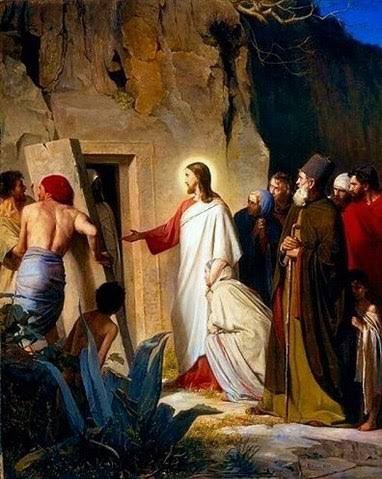
In the Gospel, Lazarus has been in the tomb for four days. Humanly speaking, everything is over. The grief of Martha and Mary is real and familiar: “Lord, if you had been here…” How often we have prayed similar words—when a relationship breaks down, when a prayer seems unanswered, when life takes a turn, we did not expect. There is faith in those words, but also disappointment.
Jesus does not ignore this tension. With Martha, He calls for deeper faith: “I am the resurrection and the life.” With Mary, He does something even more striking—He weeps. This tells us that God does not stand at a distance from our pain. He enters it. He feels it. He shares it.
And then, at the tomb, something unexpected happens. Jesus asks that the stone be removed. It seems unnecessary, even disturbing—why open what has already decayed? Yet this is where grace begins. Before resurrection, something must be uncovered.
For us, that “stone” may be very concrete. It could be a long-held resentment in a family, where years of silence have replaced love. It could be a hidden addiction, quietly draining joy and freedom. It could be spiritual fatigue—coming to Mass, saying prayers, but feeling nothing within. Sometimes it is simply fear: fear of change, fear of surrender, fear of trusting God completely.
Lent invites us not to hide these places, but to name them. To allow the stone to be rolled away.
Then comes the voice of Christ: “Come out.” It is not a general call; it is personal. He calls Lazarus by name. He calls each of us by name. And remarkably, Lazarus comes out still bound—alive, but not yet free.
That is why Jesus turns to the community: “Untie him and let him go.” New life in Christ is not meant to remain constrained. We need one another—for support, for encouragement, for accountability. A person trying to overcome anger may need to seek reconciliation. Someone battling loneliness may need to risk opening up. Someone returning to God may need the Sacrament of Reconciliation to truly experience freedom.
The first reading from Ezekiel speaks into moments when life feels dry and hopeless. Israel believed their story was over. Yet God says, “I will open your graves and have you rise.” This is not poetic language alone—it is a promise. God specializes in situations that seem beyond repair.
We see this even today. A marriage on the brink can slowly be healed through patience and grace. A young person who has drifted far from faith can rediscover God through a simple encounter or a moment of crisis. A heart hardened by years of hurt can, little by little, learn to trust again. What seems dead is never beyond God.
Saint Paul reminds us that the Spirit who raised Christ from the dead is already within us. This means resurrection is not only a future event—it begins now. Every act of forgiveness, every honest prayer, every step away from sin is already a movement from death to life.
As we approach Holy Week, the question is not whether Christ has the power to raise what is dead—He has shown that He does. The real question is whether we are willing to respond to His call.
What is the tomb in your life right now?
What is the stone that needs to be moved?
And what would it mean, concretely, for you to step out?
Lent is not simply about sacrifice; it is about resurrection. It is about allowing Christ to call us out of whatever confines us and to lead us into freedom.
This week, bring one “dead place” in your life to prayer—honestly, without fear. And listen. Because the voice that called Lazarus is still calling today.
 ANNUNCIATION DAILY ROSARY REFLECTION