1Samuel 8:4-7,10-22a /Ps. 88:16-19 /Mark 2:1-12
Brothers and sisters in Christ,
In moments of weakness, pain, or great need, we often discover our true friends. These true friends are not those who only laugh with us in good times. Rather, they are the ones who remain when life becomes heavy. They are willing to suffer with us when we suffer. Such friends are not common; they are a great treasure.
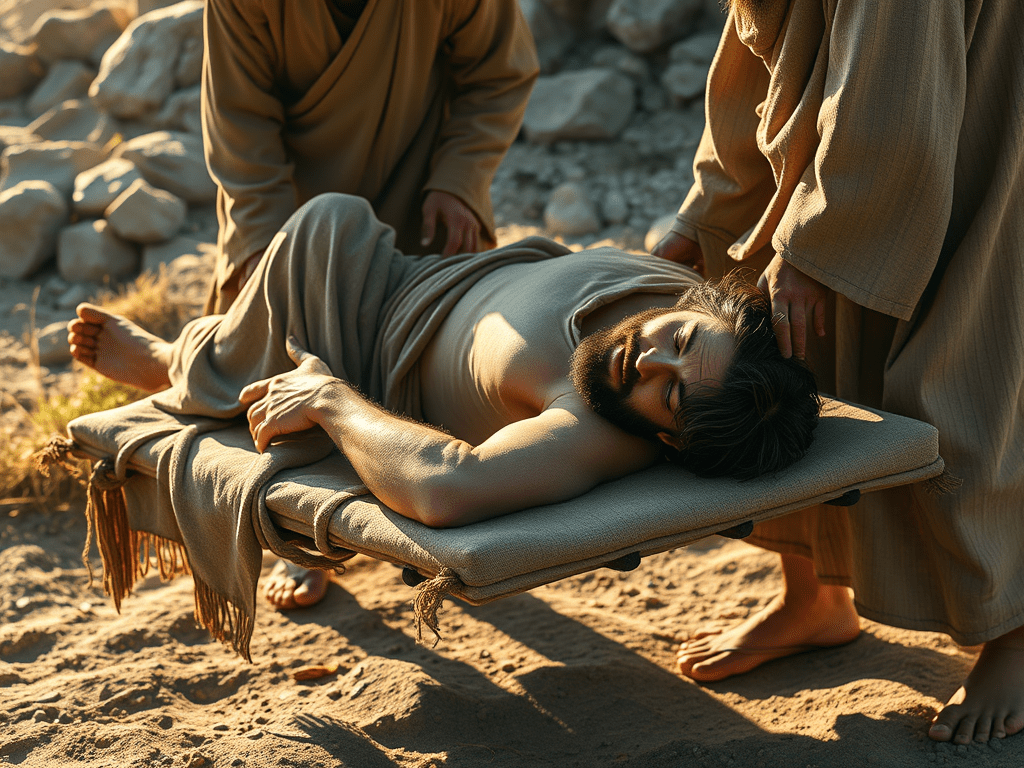
In today’s Gospel, we meet a man who was paralyzed—but even more striking, we meet his friends. This man could not walk to Jesus by himself. He couldn’t even stand. Yet, he reached Jesus because he had people who loved him deeply and believed strongly. These friends refused to be discouraged by obstacles. The crowd did not stop them. The closed door did not stop them. Even the roof did not stop them. Their faith and love found a way.
This, brothers and sisters, is a powerful image of the Church. At its best, the Church is a community of people. It is meant to carry one another, especially when someone is too weak to carry himself or herself.
Let us pause and ask ourselves:
Do we carry spiritually weak family members to Jesus through prayer?
When someone is burdened by sin, addiction, grief, or discouragement, do I help them get closer to Christ? Or do I judge them from a distance?
The Gospel tells us something very important:
Jesus saw their faith. Not just the faith of the paralytic, but the faith of his friends. Their faith moved the heart of Christ.
And then comes the surprise. Jesus does not instantly say, “Stand up and walk.” Instead, He says, “My child, your sins are forgiven.”
Why? Because Jesus sees deeper than the surface. He knows that the greatest paralysis is not always of the body, but of the soul. There are people who walk freely but are spiritually paralyzed—paralyzed by guilt, resentment, fear, shame, unforgiveness, or despair.
Many people today carry invisible stretchers:
- A marriage that is slowly breaking down
- A young person trapped in addiction
- A parent overwhelmed by financial hardship
- A heart wounded by betrayal
- A conscience troubled by sin that has never been confessed
Jesus begins with forgiveness because forgiveness heals the deepest wound.
Forgiveness restores dignity. Forgiveness tells us: You are not rejected. You are loved. You still belong to God. - Brothers and sisters, before we ask God to change our situation, He often wants to change our hearts. Before He heals our circumstances, He wants to heal our relationship with Him.
This Gospel also reminds us that sometimes we can’t hear God’s healing words by ourselves.
Sometimes we need friends of faith. We need people who pray for us when we can’t pray. We need people who bring us to church when we feel discouraged. We appreciate people who gently encourage us to go to confession. We need people who refuse to give up on us.
Think of the parent who keeps praying for a child who has wandered far from God.
Think of the friend who accompanies someone to the hospital or to the priest.
Think of the parishioner who quietly supports another with food, advice, or prayer.
Like the men who carried the paralytic, such people may never preach a sermon—but their love opens roofs.
The blessing of this miracle did not stop with the paralytic. The Gospel tells us that everyone there was amazed and praised God. Goodness always has a ripple effect. When we carry someone in love, many others are strengthened in faith.
Finally, brothers and sisters, our reflection also reminds us of an important spiritual warning. In the time of the prophet Samuel, the people demanded a king. They did not do this because God had failed them. They did it because they wanted to be like other nations. They preferred human systems to divine guidance. They trusted worldly wisdom more than God’s voice.
This temptation still exists today. We often want solutions that fit worldly logic rather than God’s will. We listen more to social trends than to Scripture. We rely more on power, money, or influence than on prayer and obedience.
But the Gospel calls us back to trust. Trust in God’s timing. Trust in God’s wisdom. Trust that God knows what we need most—even when it is not what we expect.
Brothers and sisters, as we come to this Eucharist:
- Let us ask God to heal us where we are most wounded.
- Let us ask for friends of faith-and strive to become such friends ourselves.
- Let us choose God’s truth over human conventions.
- And let us never underestimate how powerfully
God can work through a simple act of love.
May the Lord who forgave and healed the paralytic also speak healing into our lives today.
 ANNUNCIATION DAILY ROSARY REFLECTION