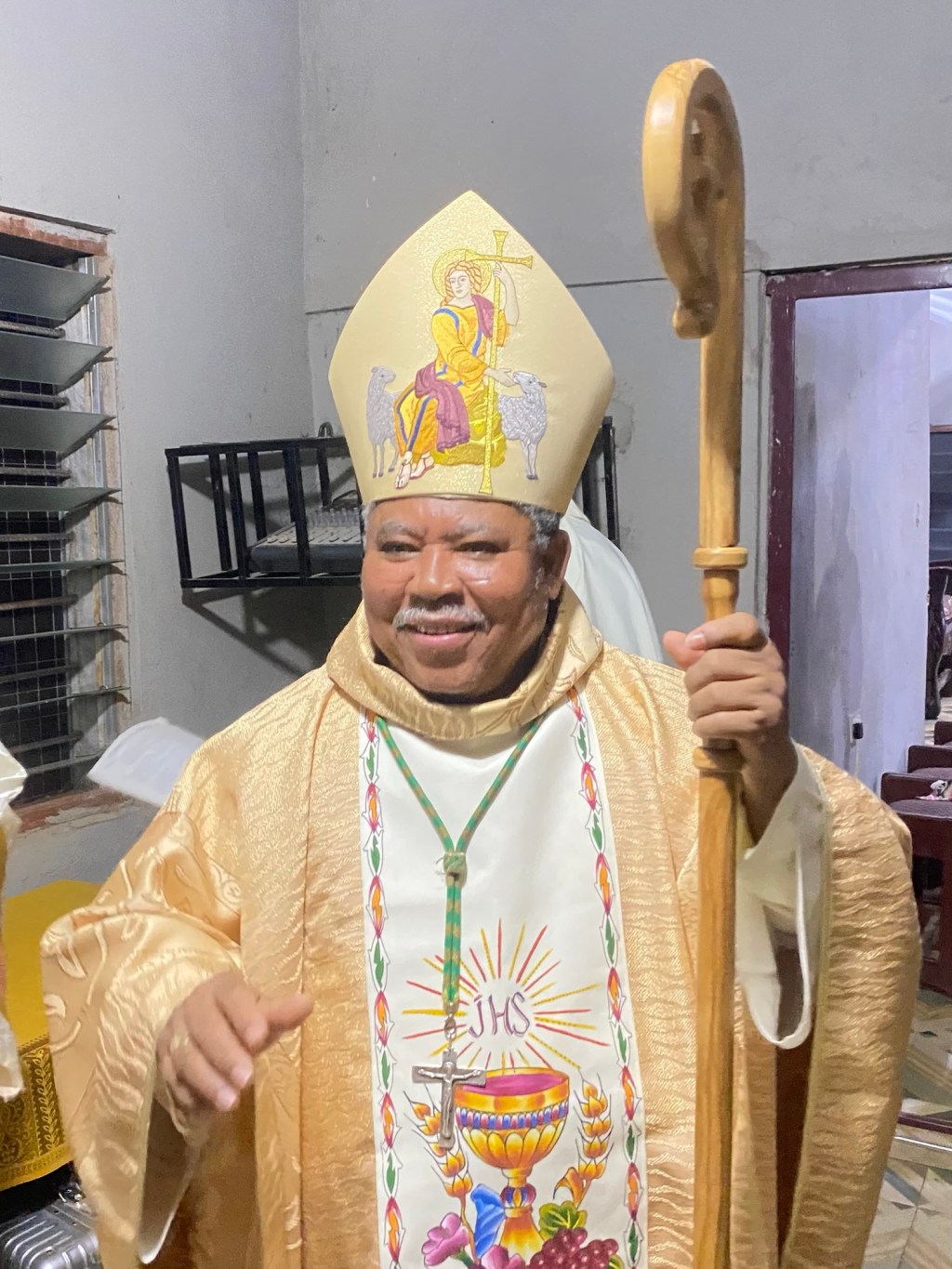
Damongo, Ghana – The Christmas Midnight Mass at St. Theresa of the Child Jesus Parish, Canteen–Damongo, was marked by deep reflection and renewed hope as Most Rev. Peter Paul Y. Angkyier, Bishop of the Catholic Diocese of Damongo, delivered a moving homily on the theme “God Cares.”
Addressing the faithful gathered to celebrate the birth of Christ, the Bishop reminded all that Christmas proclaims two central truths of the Christian faith: God became man, and God became man to save humanity from sin and evil. These truths, he noted, are the source of the joy, peace, and hope that characterize the Christmas season.
Christmas Beyond Noise and Commerce
Reflecting on contemporary society, the Bishop observed that Christmas today is often marked by fireworks, loud celebrations, and social gatherings that sometimes eclipse the sacred meaning of the feast. While some remain prayerful in churches, others await midnight in bars, restaurants, and dance halls. This reality, he said, reveals how Christmas has increasingly become a social or commercial event, often stripped of its spiritual depth.
Yet, drawing from the Gospel narrative, the Bishop emphasized that God chose to enter human history through ordinary and humble circumstances, teaching humanity a profound lesson about divine love.
God’s Providence at Work
The homily explored the historical background of the Gospel account—the Roman census decreed by an emperor. What appeared to be a mere civil ordinance, the Bishop explained, became an instrument of God’s providence. It was through this census that Joseph and the pregnant Mary journeyed from Nazareth to Bethlehem, fulfilling the ancient prophecy that the Messiah would be born in the city of David.
Despite Bethlehem being Joseph’s ancestral home, there was no room for the Holy Family. This, the Bishop cautioned, should not be read as deliberate rejection but as a consequence of an overcrowded town. Nevertheless, the image of the Son of God laid in a manger among animals remains a powerful symbol of God’s humility and closeness to the poor.
A Mirror to Today’s World
Drawing a parallel with modern society, the Bishop noted that people often choose whom to help based on perceived benefits. Many vulnerable persons—homeless individuals, migrants, and refugees—are overlooked, just as Christ was unrecognized at his birth. “God came to his own,” he said, “yet he was not recognized.”
The turning point in the Christmas story, however, comes with the angels’ announcement to the shepherds—people considered poor and insignificant by society. Their joyful response and eagerness to visit the manger reveal God’s preferential closeness to the humble and lowly.
A Call to Humility and Compassion
Linking the Gospel with the First Reading from Isaiah, the Bishop highlighted the birth of the child called Wonderful Counsellor, Mighty God, Eternal Father, Prince of Peace. This child, he said, reveals a God who cares deeply for humanity, especially the poor and forgotten.
As the Christmas season begins, the Bishop challenged the faithful to live out the message of Christmas by radiating love, humility, and simplicity. True celebration, he stressed, is found not in empty festivity but in encounters that mirror the humility of Christ.
Christmas That Transforms
The homily concluded with a prayerful invitation: that Christmas may never be empty of its true meaning, and that by learning from the humility and meekness of Christ, believers may be lifted up and become signs of God’s saving love in the world.
This homily was delivered during the Christmas Midnight Mass at St. Theresa of the Child Jesus Parish, Canteen–Damongo, and is published here for the spiritual enrichment of the wider Christian community.
 ANNUNCIATION DAILY ROSARY REFLECTION