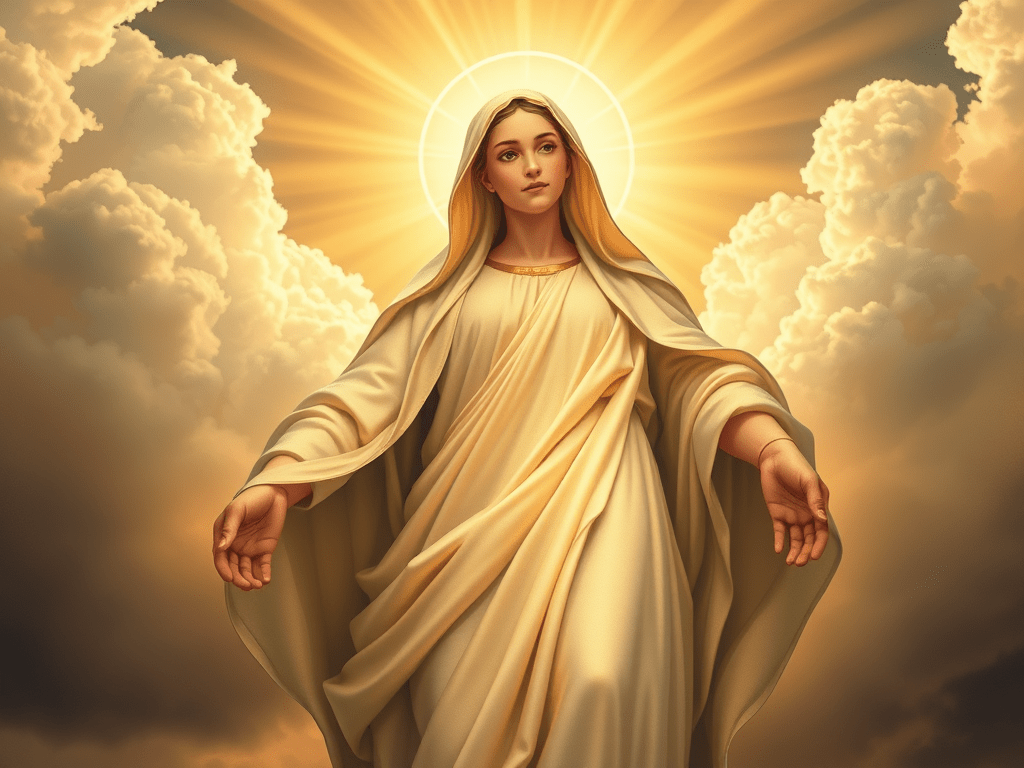
Today on 15th August, Mother Church invites us to celebrate the Solemnity of the Assumption of Mary. The feast was celebrated under various titles: Commemoration, Passing, Assumption from at least fifth century or sixth century. Today it is celebrated as a solemnity.
On 1st November 1950, Pope Pius XII issued the Apostolic Constitution Munificentissimus Deus. He officially defined the Assumption of Mary as a dogma of Faith. He declared: “By the authority of Our Lord Jesus Christ. By the blessed Apostles, Peter and Paul, and by our own. We proclaim and define it to be a dogma revealed by God. The immaculate Mother of God, Mary ever Virgin, completed the course of her earthly life. She was taken up body and soul into the glory of heaven.”
The definition uses the neutral expression ‘when the course of her earthly life was finished.’ It also uses ‘after her life on earth.’ It says nothing about Mary’s death. In fact, these words were intentionally chosen in order not to say whether or not Mary died. The definition avoids deciding between two views.
The more ‘traditional view’ states that Mary did not die but was assumed into heaven. The more ‘modern view’ believes that she died but did not experience the corruption of the grave. By mentioning the name Mary, the definition emphasizes that it is the Virgin herself who was assumed. She was taken in all the fullness of her being. While Christ ascended into heaven Mary did not assume herself so to speak but was assumed into heaven. This means that the assumption did not come about through her own power. In the Ascension of Jesus, the action was by the power and action of God. It is God who takes Mary up.
First, the dogma of the Assumption means that Mary is united with Christ in his glory. The privilege of the Assumption crowns all the gifts that Mary received from God. It is the ultimate fulfillment of her predestination in Christ and with Christ. The Assumption is a consequence of Mary’s intimate and active association with Jesus her Son in his work of redemption.
Mary was intimately joined with her son both physically in his work of redemption. She was also indissolubly united with him supernaturally during her life on earth. This connection did not end with Christ’s redemptive work on earth. It also did not end with her life on earth. Mary was linked with her son in his state of kenosis, which involved suffering. Hence, she also had to be with him in his triumph. She was with him in his triumph. She was with him as the Risen Lord. She was involved with him in his state of Kyrios. Because the Blessed Virgin Mary was conceived without sin, she was free from any fault. Thus, she should not have been exposed to the corruption of the grave. She did not need to wait until the end of the world for her body to be redeemed.
Second, there is a sense in which the Assumption is linked to Mary’s divine Motherhood. Christ’s flesh was from that of Mary. It was highly appropriate that the Mother’s body should be glorified like that of her. It is hard to believe that the holy body of the Mother of God should suffer corruption after death. Her Son’s body did not experience this. Since he was in a position to preserve his Mother from that corruption, we should believe in his filial love. He did so to have in heaven her who conceived him on earth in her virginal womb.
The bull of definition says: “it seems practically impossible to contemplate her who conceived Christ. She brought him forth and nourished him with her milk. She held him in her arms and embraced him. It is hard to consider her as separated in body from him. She is not separated in soul. This bond remains even after her time on earth was over.”
Third, theologians connect Mary’s perpetual virginity with her Assumption. She conceived virginally and gave birth without physical impairment. She is fully and perfectly an inviolate virgin. She should also be exempt from the corruption of the grave. She should be assumed with her body intact to the incorruptible life of heaven.
Fourth and lastly, the Blessed Virgin Mary was assumed into heaven. She is also the first fruits and model of the eschatological Church. The Second Vatican Council has this to say: The Blessed Virgin Mary has already reached the Church’s perfection. The faithful still strive to conquer sin. The faithful aim to increase in holiness. They aim to be more holy. They turn their eyes to Mary who shines forth to the whole community of the chosen. The mother of Jesus in the glory which she possesses in body and soul in heaven is the image and the beginning of the Church as it is to be perfected in the world to come” (LG 65 and 68)
Mary’s spiritual journey, a journey of faith reached its climax with her assumption into heaven. She shows us that we can walk this path with confidence. She has preceded us on the way of imitating Christ and her glorification is the firm hope of our salvation. The Catechism of the Catholic Church confirms this. It states that “in Mary we contemplate what the Church already is in her mystery.” We see her on her own pilgrimage of faith. We foresee what she will be in the homeland at the end of her journey.” There in glory of the most holy and undivided Trinity, the Church awaits in communion with all the Saints. She venerates the one as both mother of the Lord and her own mother as well…” (CCC 972).
Indeed, the entire body of the faithful addresses its supplications to Mary. She is the Mother of God and their own mother. Mary aided the beginnings of the Church by her prayers. Now, she is exalted above all the angels and saints. She intercedes for them before her Son in the company of all the saints. This process continues. They are happily gathered together in peace and harmony. They become the one people of God for the glory of the Most Holy and undivided Trinity. In the light of this, it is thus not surprising that Mary is called “our hope, cause of our joy.”
Mary’s assumption is not explicitly recorded in Scripture. Yet, Catholic tradition identifies her with the “woman clothed with the sun” described in Revelation 12. The woman is caught up in the battle between good and evil. Her Assumption is seen as an exemplification of the woman’s victory.
In conclusion, Mary is the model of the future glorification (in body and soul) of the members of the Church. In the Assumption, Mary is the synthesis and the accomplishment of the Church. In her is achieved the final goal of Christian faith.
 ANNUNCIATION DAILY ROSARY REFLECTION