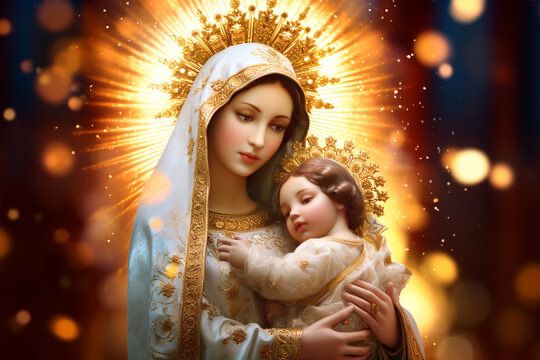
Have you ever wondered what more could be behind the basic Faith facts that you learn at school or at church? One fact the Catholic Church teaches us, is that Mary is the Mother of God. Simple, right? Many people do not know the depth that that statement brings. Theologians and Saints can go on for hours about this topic, but I will focus on the teaching of dogmas, the objections, and the support of the early Church Fathers. Mariology is a wide topic of beautiful beliefs.
First, of all, to even start this debate, we need to accept the Hypostatic Union, from the Greek word “hypostasis” that is a technical term in Christian theology employed in mainstream Christology to describe the union of Christ’s Humanity and Divinity in one hypostasis or individual personhood- this simply is that Christ being fully Man and fully God. For God to become human flesh is in itself amazing. Such an event could take place in many ways, in a castle in royal bloodlines or in a stable. It would make sense for Him to be born like any other human. Again, sounds simple but there have been heresies that doubt Jesus was human. Not only do we have to believe the human part, but also that Jesus is God and again there are heresies that doubt the divinity of God or separate as two being Jesus the human and Jesus as God.
The Church uses Theotokos as a title for Mary, which means God Bearer. By this, we believe Mary is not God, but the mother of God. One of the ways the Church defends this belief is by looking at how the Old Testament is fulfilled in the New Testament. As Elizabeth exclaimed, “And how does this happen to me, that the mother of my Lord should come to me?”, in Luke 1:43, David similarly says, “How can the Ark of the Covenant come to me?”, in 2 Samuel 6:9.
The Ark contained manna from Heaven, Aaron’s staff which signified priesthood, and God’s word; the Ten Commandments. Meanwhile, Mary brings far more than signs of God, but God himself in her womb. Jesus is more than manna He is the Bread of Life. He is more than the Ten Commandments, Jesus is our High Priest, and the Word spoke of in John Chapter One. Just as the Ark from the Old Testament was protected from sinful hands, the Church teaches that Mary, by God’s grace, was kept from original sin up to birth and throughout her life due to the special role she played in the life of Jesus. The old to the new continues; just as David leapt before the Ark, so did John the Baptist in Elizabeth’s womb.
The Ark stayed in the house of Obededom for three months, the same length Mary stayed with Elizabeth before returning home. We can truly see in these comparisons that Mary truly is the New Ark bringing forth not symbols but the real Jesus. As the New Testament is always the improved fulfillment of the Old Testament, Mary is the improved version of the Old Testament Ark which was held in such great reverence. The reason? Through her the world received not symbols of God, but Jesus, true God.
I want to stress some more important points about Mary. She was visited by the angel Gabriel and told of her role. She never doubted the message even if she did not understand how it would come to be. She received the Word of God in her heart through her words, “may it be done unto me according to your word.” By the Holy Spirit she received the Word into her body and gave life to the world. As Catholics, we acknowledge and honor Mary as being truly the Mother of God and the Mother of the Redeemer. She was redeemed by the merits of her Son and she is endowed with the high office and dignity of being the Mother of the Son of God, the beloved daughter of the Father, and the temple of the Holy Spirit.
The Catholic Church, taught by the Holy Spirit, honors her with affection and piety as a most beloved mother. Her role is 100% derived from the merits of Jesus, the Catholic Church does not teach that Mary earned this role. Because of her role Mary is infused with more grace than any other creature, but she still needs a Savior because she is a relative of Adam and Eve. Jesus died on the Cross for Mary also. Mary is the Mother of the offspring that will strike at the serpent’s head while he strikes at the heels of Mary’s offspring in Genesis 3:15. She is the Virgin who shall conceive and bear a son, whose name will be Immanuel in Isaiah 7:14.
Another resource, Lumen Gentium, arising out of Vatican II, shows us in what regard we should hold Mary in the ranks of the Church. In paragraph 52, it states, “Joined to Christ the Head and in the unity of fellowship with all His Saints, the faithful must in the first-place reverence the memory, “of the glorious ever Virgin Mary, Mother of our God and Lord Jesus Christ.” Mary is indeed the Queen of all Saints. These obvious reasons defined by the Catholic Church shows us why Mary is the Mother of God, yet some people are blinded with their own beliefs or have never been exposed to the depth of these teachings.
When a broad topic like this is brought up, many objections are brought to the surface. One basic objection against the Catholic Church is that we worship Mary. For a basic question comes a short and sweet answer, we do not worship Mary but honor her as the Mother of God. As Catholics we indeed love Mary, but worship is reserved for the Holy Trinity. She is given to us by Jesus at the foot of the cross as our mother in John 19:27, “Behold your Mother.” I once heard a quote that said, “No one can love Mary as much as Jesus does”. This is at the very foundation of how we are to view Mary, to love her as Jesus did.
One Protestant objection states that Mary is not the Mother of God, she was only the mother to the man Jesus. This objection stems from Walter Martin, a Protestant apologist. Martin got so twisted that he claimed Jesus was only the Son while on earth, He was not the eternal Son, and God the Father was not the eternal Father. But let’s take a look at the Gospel of John. “In the beginning was the Word and the Word was with God, and the Word was God”(John 1:1). We see Jesus was with God in the beginning and was the Word in John 1:14, “ And the Word became flesh and dwelt among us, and we saw His glory, the glory of the Father’s only Son, full of grace and truth.” Jesus is the Word who became flesh through Mary. If we compare this verse to John 1:1, we can see that Jesus, the Word, was with God in the beginning, and that Jesus is God. The Trinity has always been; therefore God has always been the Eternal Father. Faithful Catholics believe that Jesus was God at all times, even at birth and conception.
Another Protestant apologist, Eric Svendsen has four objections to Mary as the Mother of God. First, Svendsen states that Jesus severed all ties to Mary before he went to the Cross. Svendsen points out Matthew 12:46-50 where Jesus states, “Who is my Mother? Who are my brothers? Then pointing to his disciples he said, “Here are my mother and my brothers. For whoever does the will of my Heavenly Father is my brother, sister, and mother.” Svendsen says that Jesus is demeaning His mother. To which Catholics would respond; who better did the will of the Heavenly Father than Mary? Jesus was making the point that direct family ties do not take priority in His kingdom but doing the Father’s will. Again, at the foot of the cross, Jesus tells St. John, “Behold your Mother.” This certainly does not indicate a severed tie to Our Blessed Mother. Svendsen also ignores Acts 1:14, “All these devoted themselves with one accord to prayer, together with some women and, Mary the Mother of Jesus…”
The second objection that Svendsen makes is that the title for Mary is now used solely as an excuse to worship her. For instance, the Basilica of St. Mary Major in Rome built by Pope Sixtus. St. Irenaeus states in his works titled, “Against Heresies”, “The Virgin Mary…being obedient to His word, received from an angel the glad tidings that she would bear God.” We look up to Mary, hoping to be obedient like her to God’s will. The Ark of the Covenant was both greatly sacred and respected; therefore, we respect the new Ark, Mary the Mother of God. St Ephraim, in his Songs of Praise states, “The Virgin became a Mother while preserving her virginity; And though still a Virgin she carried a Child in her womb; And the handmaid and work of His Wisdom became the Mother of God.” We are all called to be the hands and feet for God, and what better person to ask for our intercession than the Mother of God, who had God within her very own womb.
Eric Svendsen’s third objection is that Mary gave birth to a person who is both God and man. She did not give birth to the pre-incarnate form, the Word of God. Svendsen makes the mistake once again of dividing Jesus into two parts, human and divine. We acknowledge the Bible does not directly state Mary as the Mother of God, but we know Jesus is God. Svendsen makes the error of insinuating Jesus changed from human into divine. St. Cyril brings to the table that if Mary was just the mother of Jesus’s physical body but not the mother of God, then this would mean Christ was divided into two separate natures, one human, and one divine, but Jesus is not divided.
Tim Staples, the author of “Behold your Mother”, points out that God has been perfect for all of eternity and is unchanging. There is no Pre-Incarnation form of God that differs from the form of God after the Word became flesh. In Malachi 3:6, it says, “For I the Lord do not change.” It may be hard for us to wrap our heads around and we will never be able to fully comprehend God’s great graces. The Council of Chalcedon writes, “Though He assumed flesh and blood, He remained what He was, God in nature and truth. The Word is unalterable and absolutely unchangeable, always remaining the same.”
Svendsen’s fourth and final objection states the Council of Ephesus denies Christ was fully human. He claims that the Council of Chalcedon just 25 years later contradicted the Council of Ephesus. The problem is that Svendsen pulled one quote out of context from a large document. The Church has always taught from the beginning, and through the Councils, to refute heretics that Jesus Christ, the second person of the Trinity, is one person with two inseparable natures. So, in short, Catholic believe Jesus is the Eternal Word that became flesh, the Word was conceived by the Holy Spirit and born of Mary, Jesus is fully Divine and fully human, and Mary can be the Mother of Jesus and not be the Mother of the Trinity. Protestants believe Mary is the mother of only Jesus’s human nature as if she gave birth to part of Jesus.
They contend Mary would have to be God to give birth to God. This leads to the final point the Protestants ask, “Are you saying Mary beget the soul of Jesus?” No, God gave a soul to all of us. Therefore, God is the source of the soul. Mary gave birth to a baby that had a body and a soul.
We as Catholics do not engage Protestants to win an argument, but rather in deep love for Mary and the gifts she brings to followers of Jesus. Like the Holy Eucharist, we long for all brothers and sisters in Christ to share in Mary, for she is their mother as well. We want all followers in Christ to see how dedicated Mary is in following Jesus and how her gifts of total acceptance of the will of God, reflected in her let it be done onto me according to thy word, the fulfillment of the New Ark of the Covenant in Mary, her Immaculate Conception, Jesus giving His Mother to be our Mother at the foot of the Cross and the Assumption are all complete gift from a God who selected her for this high office in the earthly ministry of God. When Christians understand Mary, they do not dilute the importance of Jesus, they magnify that importance and this would be a great step for unity in the Church on earth,
In the early Church, the great leaders, known as the Early Church Fathers were often fighting heresy. From Arius to Nestorius and others, the defense of Church teaching has been a part of the mission for 2,000 years, it comes with the territory.
In some cases, we use one Church teaching or dogma to prove another. Tim Staples points out getting the teachings on Mary right will often allow us to get our theology on Jesus right. One such case deals with Arius and his teachings on the divinity of Jesus known as the Arian heresy or Arianism. Arianism teaches that Jesus is not truly divine, but a created being. Arius, who lived in the fourth century believed that God alone was not capable of change and Jesus is not God, but a creature with a beginning. Arius taught that God created a superior creature called Logos, which means the Word. After creating Logos, God made all other creatures through logos. At a point in time, God made it possible for Logos to take human form through a woman. In this way, Logos was not immediately perfect, but through life made progress towards perfection.
By God‘s will, the death of Logos was redemptive; he saved us and was then promoted back to his perfect being. To believe this, Arius would have to disregard John 1:1-2. Arius believed that “the Word” was a great creature, but not God. To Arius, the incarnation, the Word taking flesh as the Son of God in the human womb of Mary was a non-starter. Arius was a wonderful orator, who had the gift of persuasiveness. He built a sizable following, including some Catholic bishops. And this Arian movement was not a passing fad; it lasted for almost four centuries. St. Athanasius was a key figure in the fight against Arianism. Athanasius, who today is celebrated as a doctor of the Church, was born in Egypt and had a role under Alexander the bishop of Alexandria and later became the bishop. Athanasius really picked up the challenge with great urgency when he took the role.
Athanasius was actually sent away, exiled, five times. Athanasius used this time for writings against every aspect of Arianism. One of the arguments used by Athanasius involved Theotokos. Mary would be essential to proving that Christ was really human and really divine. Athanasius argued that Mary was indeed God Bearer, not the bearer of a created Logos. In 325, the Council of Nicea concluded that Jesus was indeed divine, of the same nature as God the Father.
The teaching of Mary as Theotokos grew in popularity, but Nestorius, the Archbishop of Constantinople, raised an objection that split Jesus into Jesus as God and Jesus as man. Nestorius offered the term Christokos, Christ bearer, instead of God bearer. He argued that Mary was only the mother of the purely human Jesus who had a human nature and a human person.
Nestorius believed that only after his birth did the divine nature and person return to Jesus. At the rejection of Theotokos, Pope Celestine appointed Bishop Cyril of Alexandria to lead the Council of Ephesus, the fourth largest city in the Roman Empire. There is a small home in Ephesus that has been excavated, that tradition tells us was the home in which John took Mary after the crucifixion. The home overlooked the temple of Artemus, the Roman goddess of fertility. It is amazing that the Mother of the Church resided above the false Roman goddess.
Transportation was an issue in the fourth century so getting word out to all the bishops to advise them of the Council and then travel time for the bishops to Ephesus was indeed a slow process. Cyril began to grow impatient waiting for all the bishops to arrive. Only the Egyptian delegation, who fully supported Cyril, and Nestorius were present. Nestorius would not participate until the other bishops arrived. Cyril started the Council and in short order the Egyptian bishops proclaimed their position and officially denounced Nestorius.
When the other bishops arrived, even though they fully believed Christ was divine and agreed with the title of Theotokos, they were greatly offended that Cyril proceeded without them and viewed the time spent in discussion and the final writing as inadequate.
There were excommunications, house arrests and all kinds of chaos, but by 433 the language explaining Theotokos was finalized. The Formula of Union put together by Syrian bishops was accepted and shown here, “A union of two natures has been affected and therefore we confess one Christ, one Son, one Lord. By virtue of this understanding of the union which involves no merging, we acknowledge the Holy Virgin to be “Mother of God” because God the Word “became man” and united to himself the temple He took from her as a result of His conception.”
St. Ignatius of Antioch shows us in his writings that our God was conceived in the womb of Mary. St. Irenaeus of Lyons condemned people like Nestorius. He took on the Gnostics. He pointed out the unchangeable nature of Jesus, showing that the same person with that nature suffered and died for us. Therefore, He was God in Mary’s womb. Many teachings of Mary and Jesus go hand in hand. These Fathers support the teaching of Theotokos or Mary, Mother of God and their era refutes the claim that this teaching was invented later. Our Catholic beliefs today are rooted in both Scripture and Sacred Tradition which in many cases was more fully explained by the Early Church Fathers, some of which were instructed by the Apostles.
In conclusion, we can clearly see that Mary is the mother of God. Tim Staples book “Behold Your Mother”, gives us many great defenses to use against Protestant objections as do Vatican documents and the writings of the Early Church Fathers, I have cited only a few of these sources, many more are available. We can also find examples of Mariology when we compare books in the Bible. From my Mariology class, I learned more about the dogmas of the Church, the objections raised against our teaching, and ways to refute these arguments. Overall, I have a better understanding of Mary, not only as the Mother of God, but also as my Mother. I strive to be more like Mary everyday and trust God’s will, knowing a simple “yes” could lead to great wonders.
Authored by Elizabeth Homyk
BIBLIOGRAPHY
Staples, Tim, Behold Your Mother; A Biblical and Historical Defense of the Marian Doctrines. Catholic Answers Press (2014) – Chapters 1 and 2 and Appendix A
The New American Bible, Catholic Bible Publishers (1970)
Juergens, William A. , The Faith of the Early Fathers, Volume 1. Liturgical Press (1970)
Complete and Updated Catechism of the Catholic Church. Doubleday (1994)
Lukefahr, Fr. Oscar, A Catholic Guide to Mary; Christ’s Mother and Ours. Liguori (1998)
McBride, Alfred, Images of Mary, St. Anthony Messenger Press (1999)
 ANNUNCIATION DAILY ROSARY REFLECTION
Leave a comment